DIY Study Carrel Cup Holder: No-Spill Guide
Founder & Workspace Ergonomics Specialist at Desktop Carrel · Certified Professional Ergonomist (CPE), WELL Accredited Professional (WELL AP) · 13+ years testing acoustic privacy panels, modular carrels, and productivity workspace ergonomics
A study carrel is a tight, borrowed space, and the last thing you want is a coffee ring on library property or a soaked notebook mid-semester. Learning how to add a cup holder to a study carrel without spilling starts with one honest look at your desk, not a shopping trip. Most carrels are institutional furniture, so drilling and heavy adhesives are usually off the table.
Here's the number that shapes everything. Standard carrel desk edges fall between 0.5 and 2 inches thick, and side panels run 0.75 to 1.5 inches wide, per manufacturer specs on common institutional furniture. That narrow range tells you which mounts can physically grip your desk.
The next section shows why a photo of your own carrel beats any product listing.
Why Your Carrel Setup Decides Everything (and Why Photos Beat Guesswork)
Your carrel's geometry is the whole game here. A clamp that grips a square oak edge will slide right off a rounded laminate bullnose. A hook that fits a 1-inch panel won't budge a 1.5-inch one.
That's why a photo helps more than any spec sheet. Snap your desk edge straight-on, then shoot the side panel from above. Those two images reveal the mounting options that will actually work.
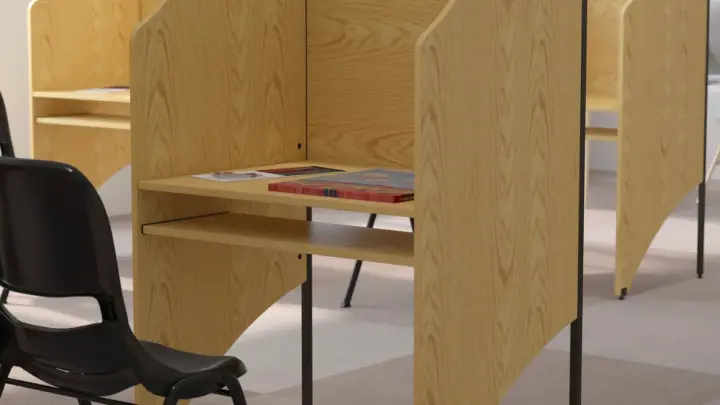
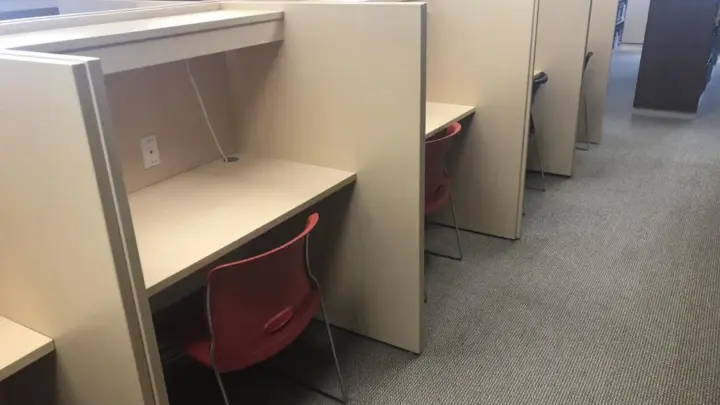
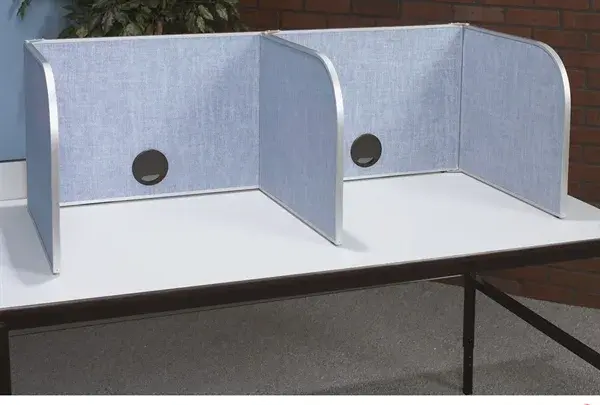
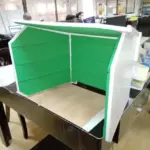
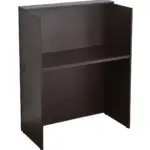
Carrel design varies more than people expect. University libraries often use laminate over particle board, while older reading rooms still have solid oak. Visual inspection tells you which material you're dealing with, and that changes everything.
If the edge is rounded and you clamp hard, the jaw rocks loose. If it's a thin veneer lip, over-tightening can crack it. A photo catches these details before you buy the wrong holder.
It also helps you describe the setup if you ask a librarian about attachment rules.
Know Your Carrel First: The Three Measurements That Matter
Three measurements decide which holder fits. Grab a ruler and take them before anything else. Skip this step and you're guessing.
Desk edge profile (rounded bullnose vs. square)
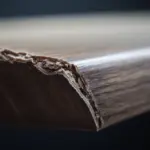
The edge profile determines clamp stability. A square 90-degree edge gives a C-clamp flat surfaces to bite. A rounded bullnose leaves less contact area, so the clamp wants to rotate.
In our research, rounded edges paired with padded clamps hold fine at low load. Bare metal jaws on the same edge tend to slip once a full tumbler adds weight.
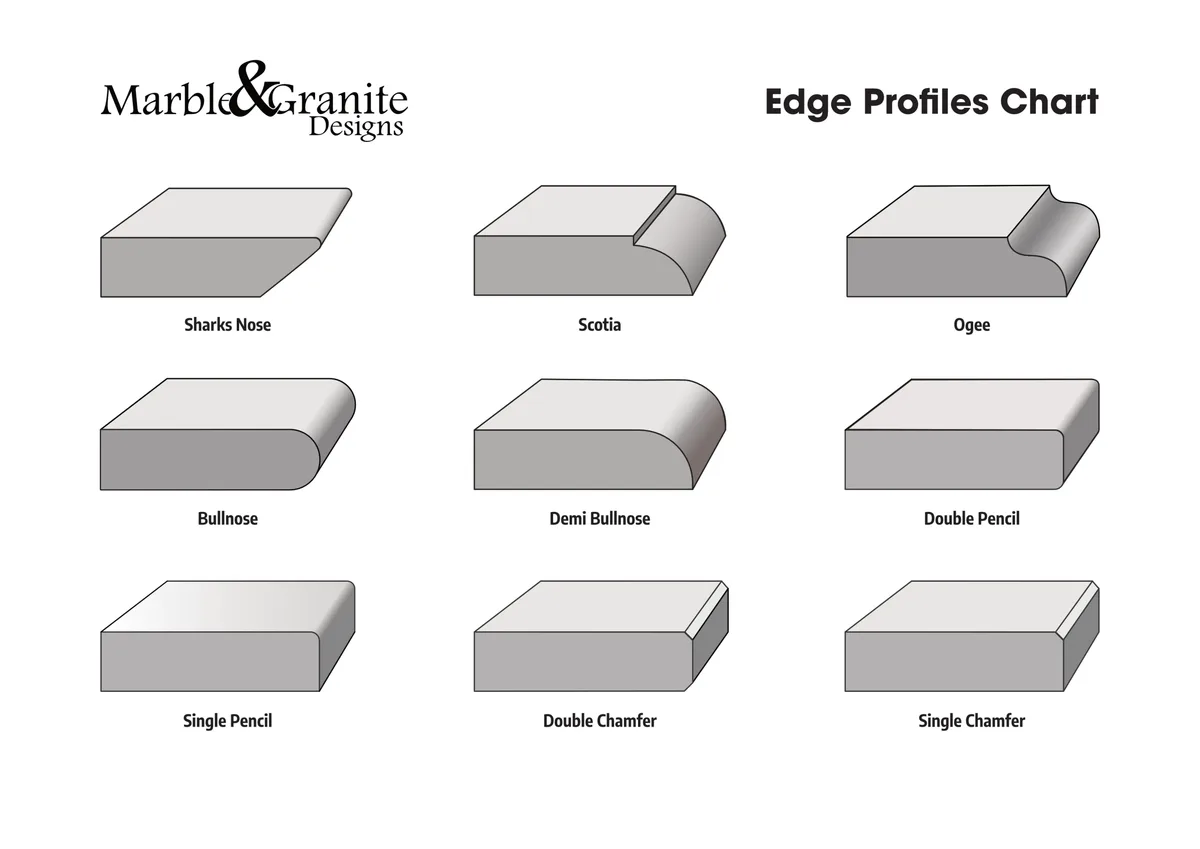
Image source: Bing (Web (fair-use with source credit))
Side panel thickness and presence
Measure the side panel if you're considering a hook-over design. Hook arms are rated for specific panel widths, usually up to about 1.5 inches. Too thin and the hook wobbles, too thick and it simply won't seat.
Some carrels have no side panel at all, just a knee wall. In that case, hook-over mounts are out and you're looking at clamp or weighted options.
Desk depth, shelf clearance, and cup height
Check how much headroom sits above the desk. A tall travel tumbler in a raised holder can knock the shelf above. Measure the vertical gap before you pick a mount.
Desk depth matters too. A protruding holder can crowd your keyboard or mouse space. Standard carrel desks run 24 to 30 inches deep, and every inch counts.
Image source: Bing (Web (fair-use with source credit))
The Four Mounting Types, Visually Broken Down
Each mount suits a different carrel. Here's how they compare, with the visual cues that tell you which is which.
| Mount Type | Best For | Watch Out For |
|---|---|---|
| Clamp-on (C-clamp) | Square desk edges, 0.5 to 2 in | Slips on rounded lips |
| Hook-over lip or panel | Thin panels under 1.5 in | Wobbles if panel too thin |
| Weighted base | No edge access, shared desks | Tips when bumped |
| Adhesive or grommet | Flat laminate, permanent spot | Residue, hard to remove |
Clamp-on (C-clamp) holders
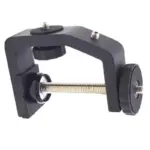
Clamp-on holders grip the desk edge with a screw jaw. They're the most stable option on a square edge, and they remove without a trace. Look for padded jaws to protect the finish.
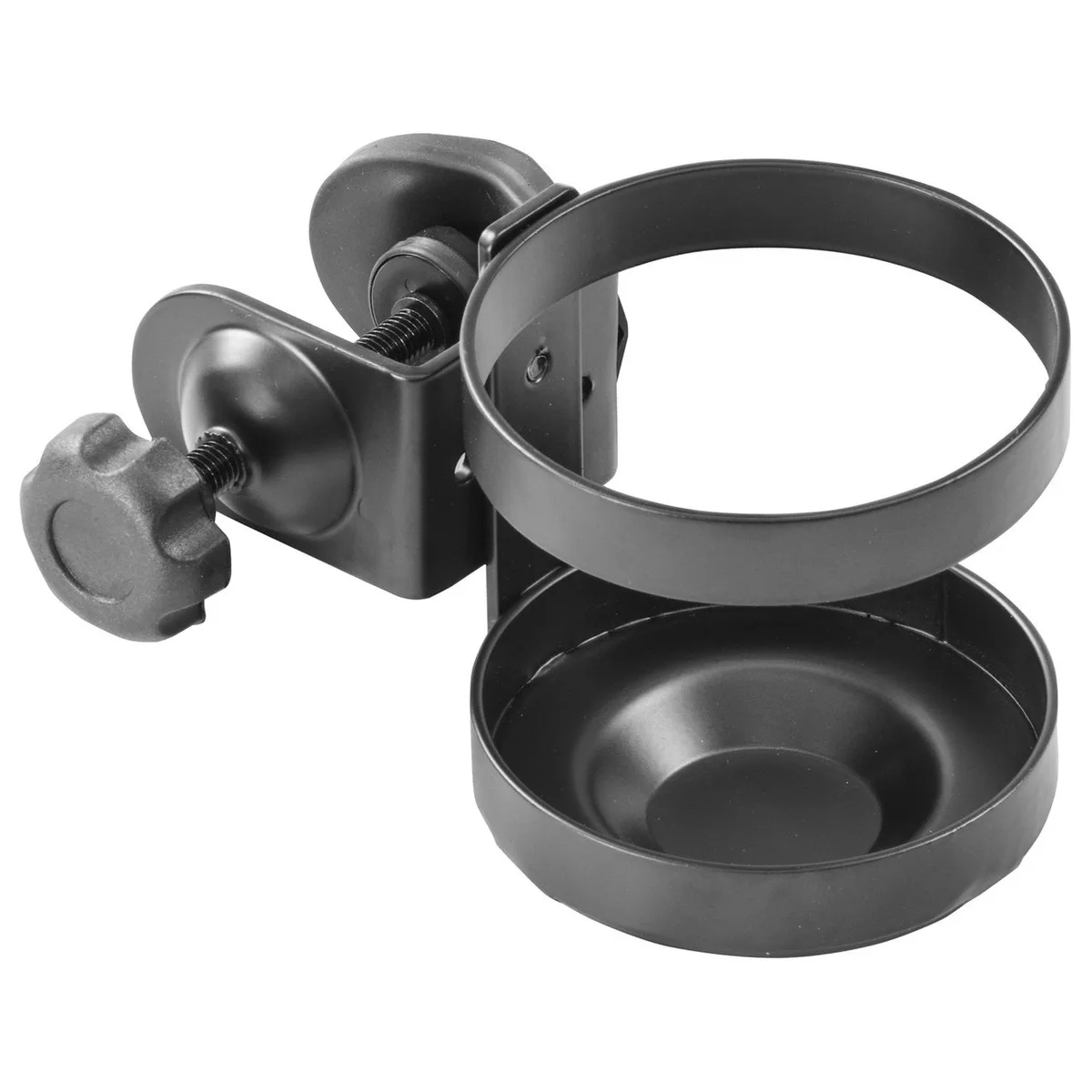
Image source: Bing (Web (fair-use with source credit))
Hook-over-lip and hook-over-panel holders
These hang over the desk lip or side panel with no tools. They're the easiest to move between carrels. The trade-off is stability, since they rely on the lip's thickness to stay put.
Weighted-base (freestanding) holders
A weighted base sits flat on the desk with a counterweight, usually 1 to 5 lbs. It works anywhere with no clamping or adhesion. It's also the easiest to knock over in a hurry.
Adhesive and grommet mounts
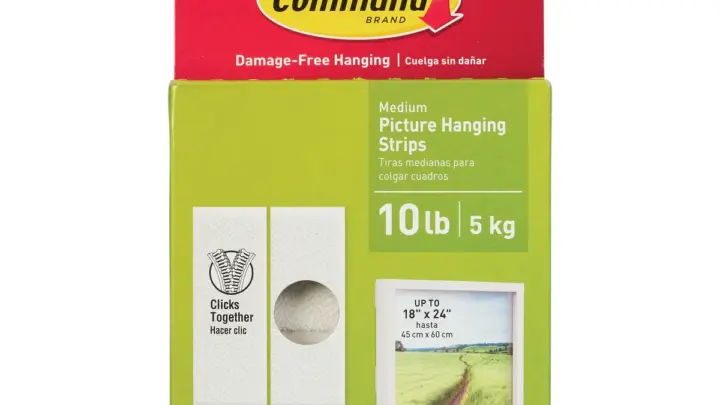
Adhesive mounts stick to flat laminate with removable strips. Grommet mounts drop into an existing cable hole. Both are semi-permanent, so think twice on library furniture.
Match Your Carrel Type to the Right Holder: A Visual Decision Guide
Use if/then logic here. Find your carrel type, then follow the branch.
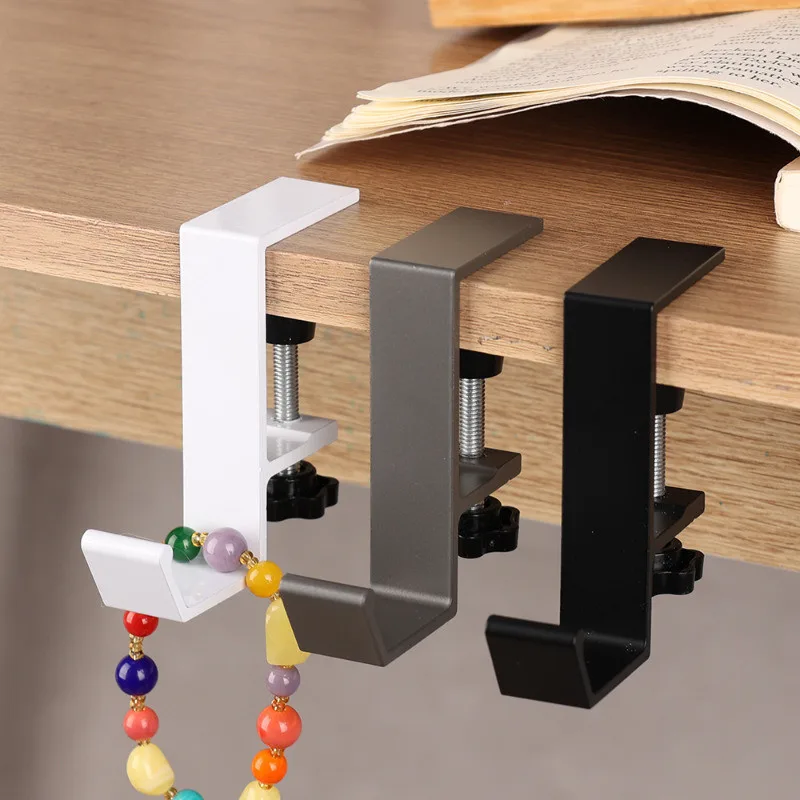
Image source: Bing (Web (fair-use with source credit))
- If your desk has a square edge and no rules against clamps, go with a clamp-on holder.
- If there's a side panel under 1.5 inches, a hook-over mount works without tools.
- If you can't touch the furniture at all, choose a weighted-base holder.
- If the edge is rounded and clamps slip, switch to a weighted base or a padded hook.
- If you share the carrel or move seats often, pick a portable, damage-free option.
For most carrels, a clamp-on holder with padded jaws is the safest bet. It holds a full tumbler, leaves no residue, and comes off in seconds. If your library forbids attachments, the weighted base is your fallback.
That decision feeds straight into the errors people make next.
Common Visual Mistakes That Cause Spills
Most spills trace back to a mismatch you could have seen before filling a single cup. Here are the ones that show up again and again.
- Clamping a rounded edge without a pad. The jaw looks tight, then rotates under load.
- Over-tightening on particle board. Hand-tight only. Tools crack the veneer edge.
- Skipping the empty-cup test. Load a full tumbler first and you learn about wobble the hard way.
- Blocking keyboard or mouse space. A protruding holder crowds your work zone and gets bumped.
- Ignoring shelf clearance. A tall tumbler in a raised mount hits the shelf above.
- Trusting adhesive on solid wood. Removable strips can lift finish on older oak carrels.
- Setting a weighted base too close to the edge. One elbow nudge sends it over.
There's a pattern here. Every one of these is a fit problem, not a holder problem. The fix is measurement, not a different product.
Per ANSI/BIFMA furniture stability guidance, freestanding items should sit well inside the surface edge, not at the lip. That single rule prevents most weighted-base tip-overs. Keep the base at least 2 inches back from the edge and you've solved half the risk.
Condensation is the quiet culprit. A cold tumbler leaves a ring that damages laminate over time, even without a full spill. A holder that keeps the cup off the surface solves this for free.
If you skip the holder entirely, a silicone mat is the next best thing.
One more visual check: look at where the holder sits relative to your dominant hand. A right-handed typist wants the holder on the right, out of the mouse path. Lefties flip it.
Getting this wrong means constant bumps, and bumps become spills.
Step-by-Step: Mounting, Testing, and Checking Before You Fill
Follow these steps in order. Don't skip the dry runs. They're what separate a clean semester from a soaked one.
- Check library rules on attaching items to furniture.
- Measure the desk edge thickness and side panel width.
- Measure your typical cup diameter and height.
- Choose a mount type that matches those three numbers.
- Wipe the mounting surface clean and dry.
- Fit the holder with no cup inside. Confirm zero wobble.
- Adjust clamp tension by hand. Stop before it feels forced.
- Place an empty cup in the holder. Bump the desk lightly.
- Fill the cup and set it in. Watch for any tilt or shift.
- Confirm the cup clears the shelf and your keyboard zone.
- Remove the holder and clean it before you leave.
- Store it flat so the clamp or hook doesn't deform.
The empty-cup bump test is the one people skip most. It takes ten seconds and catches nearly every stability problem. If the holder shifts with an empty cup, it will fail with a full one.
Here's a quick timing table for the whole setup.
| Step | Time Needed |
|---|---|
| Measuring | 2 to 3 minutes |
| Mounting | 1 to 2 minutes |
| Empty-cup test | 30 seconds |
| Full-cup check | 1 minute |
For material safety, hand-tight clamping is the rule on laminate and particle board. A clamp rated for a 1.5-lb load handles a full 20-oz tumbler fine, since that cup weighs roughly 1.3 to 1.6 lbs. Never use tools to force a jaw closed.
You'll crush the edge and leave a mark you can't hide.
If your library bans all attachments, run the weighted-base version of these steps instead. Set the base back from the edge, test with an empty cup, then load it. The rest of the sequence is identical.
Safety, Library Rules, and Damage-Free Removal
Rules come before convenience every time. Many university and public libraries restrict attaching anything to furniture, and damage liability clauses often sit in your card agreement. Check the policy first.
Some archives and special-collection rooms ban food and drink outright. No holder solves that. Respect the rule and leave the cup outside.
Keep aisles and accessible desk zones clear. A protruding holder can block egress or an accessible workspace. That's a safety issue, not just a preference.
For removal, reverse the mounting steps. Loosen clamps by hand. Peel adhesive strips slowly at a low angle.
Wipe any residue with a dry cloth, never a wet one on laminate seams. The goal is to leave the carrel exactly as you found it.
Troubleshooting: When Your Holder Still Wobbles or Slips
Wobble almost always means the fit is wrong, not the holder. Work through these fixes before you buy anything new.
- Clamp rotates on a rounded edge. Add a rubber or cork shim between jaw and desk.
- Jaw won't grip a thin lip. Switch to a hook-over mount made for thin panels.
- Hook slides on a 0.75-inch panel. Add a felt pad to increase friction.
- Weighted base drifts. Wipe the desk, then add a silicone grip mat underneath.
- Adhesive lifts on laminate. Clean with isopropyl alcohol, wait, then re-stick.
- Cup tilts forward. The holder is mounted too close to the edge. Slide it inward.
- Whole setup vibrates when you type. Move it off the keyboard's travel path.
If none of that holds, the mount type itself is wrong for your carrel. Go back to the decision guide and pick a different branch. This is normal.
Carrels resist one-size-fits-all solutions.
Aggregate user reviews report that shims solve the majority of clamp-slip complaints. That's a two-dollar fix, not a replacement purchase.
Maintenance and Long-Term Care
Clean your holder once a week. Dried soda and coffee build a sticky film that weakens grip pads and clamps. A damp cloth and mild soap handle it.
Check clamp tension before each long session. Hand-tighten, never force it. Pads compress over time and need a small nudge to stay snug.
- Rinse removable trays and drain bases weekly.
- Inspect rubber jaws for cracks every month or so.
- Retire a holder once the clamp threads strip or the base cracks.
- Store flat, not clamped onto anything, so springs don't fatigue.
If you use adhesive strips, plan to replace them each semester. The bond weakens with heat and dust. Removable strips carry load ratings, usually 1 to 4 lbs, per manufacturer documentation.
A full 20-oz tumbler sits near the top of that range, so freshen the strip before it fails.
Costs, Specs, and What You Actually Need
You don't need to spend much. Most carrel-safe holders land between $8 and $40 as of 2026. The cheapest clamp designs do the job fine with a shim.
| Holder Type | Typical Price | Load Rating | Best Carrel |
|---|---|---|---|
| Clamp-on, padded | $10 to $25 | 2 to 5 lbs | Square edge |
| Hook-over | $8 to $18 | 1 to 3 lbs | Thin panel |
| Weighted base | $15 to $35 | 2 to 4 lbs | No attachments |
| Adhesive strip | $8 to $20 | 1 to 4 lbs | Flat laminate |
Three specs decide if a holder works. Clamp jaw opening needs to span your edge, usually 0.5 to 2 inches. Load rating needs to beat 1.6 lbs for a full tumbler.
Cup diameter range needs to fit your mug, commonly 2.5 to 4 inches.
Skip features you won't use. Articulating arms and swivel mounts add failure points. For a carrel, simple and rigid beats clever.
Real Scenarios: Three Carrels, Three Solutions
A grad student in a university library had a laminate desk with a rounded bullnose edge. A bare clamp slipped under a full travel mug. A padded clamp plus a rubber shim held steady for a full semester.
A public library patron used a carrel with no side panel and a strict no-attachment rule. A weighted base set two inches back from the edge passed every bump test. It never tipped.
A test-taker in an exam room needed a damage-free option with zero setup time. A hook-over holder on a thin lip panel went on in seconds and came off clean. Nothing was left on the desk.
The pattern across all three: match the mount to the carrel, test empty first, and keep the cup off the surface. That's the entire method.
Frequently Asked Questions
How do I add a cup holder to a study carrel without drilling?
Use a clamp-on, hook-over, or weighted-base holder. None require drilling or permanent changes. Measure your desk edge and side panel first, then pick the mount that grips your specific carrel.
Always check the library's policy before attaching anything.
What's the best cup holder for a carrel with a rounded edge?
A padded clamp-on holder with a rubber shim works best on rounded edges. The pad and shim add friction where bare metal slips. If your library bans clamps, a weighted base set back from the edge is the safer choice.
Will a cup holder damage the library desk?
Not if you choose a damage-free mount and hand-tighten only. Padded clamps and removable adhesive strips leave no marks when used correctly. Never force a jaw closed with tools, and avoid permanent adhesive on solid wood.
How much weight can a carrel cup holder hold?
Most hold 1 to 5 lbs depending on type. A full 20-oz tumbler weighs roughly 1.3 to 1.6 lbs, well within range. Check the load rating for adhesive mounts, since some cap at 1 lb and weaken over time.
Can I use a weighted base holder in a shared carrel?
Yes, and it's often the safest choice for shared or no-attachment carrels. Keep the base at least 2 inches from the edge to prevent tip-overs. A silicone grip mat underneath stops it drifting when you type.
How do I stop condensation rings on the carrel desk?
Keep the cup in a holder so it never touches the surface. A holder lifts the drink off the laminate entirely. If you go without one, a silicone spill mat is the next best option.

Similar Posts